
The National ISPS Coordinating Authority continuously monitors the maritime security situation in the Black Sea and the Sea of Azov.
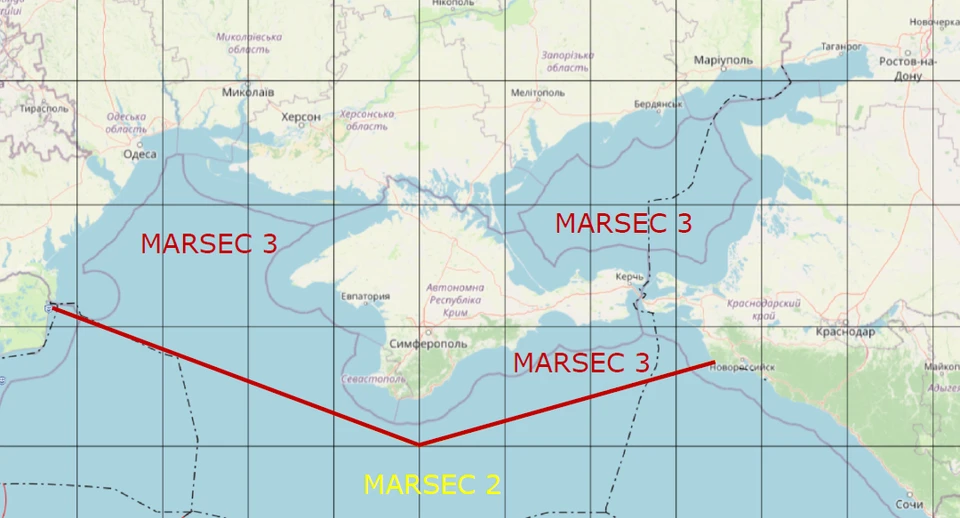
On June 2026, the National ISPS Coordination Authority issued an OXXO continuation message of the implementation ISPS MARSEC 3 issued on the 9 March 2022 for the North Western Black Sea, Crimea and the Sea of Azov north of line: 45°08N-29°48E - 44°00N 34°00E - 44°43N-37°27E. The security risk for civilian shipping in these areas remain. The National ISPS Coordination Authority therefore maintains MARSEC 3 for these areas.
MARSEC Level 3 (Ukrainian ports), in force since 28 February 2022, remains applicable. The wider of the Black Sea remains at MARSEC Level 1 until further notice.
Be aware of possible GPS jamming, AIS spoofing, communication jamming and cyberattacks in the area. Harassment and diversion of shipping in the area cannot be excluded.
The wider Black Sea ISPS level is increased from ISPS level 1 (MARSEC 1) to ISPS level 2 (MARSEC 2), excluding territorial waters of Romania, Bulgaria, Turkey and Georgia.
Increase of MARSEC level in the wider Black Sea is due to the development of the Russian Ukrainian war and its security impact on the Black Sea region.
Naval mines in the Black Sea continues to be a danger to civilian vessels. Reports indicate unintentional detachment of naval mines from original locations within the Black Sea. Civilian shipping in the south and southwest Black Sea is encouraged to maintain effective lookout and avoid floating objects.
Be aware of possible GPS jamming and AIS spoofing which may impact navigational safety.
Be advised to monitor all Ukrainian authorities issued navigational warnings on www.navtext.net and from NATO Shipping Centre, https://shipping.nato.int/nsc, including warnings from Spanish Navy NAVAREA.
It is recommended to turn your AIS on at all times, and clearly state your intentions on VHF. It is recommended to adhere to any instructions given from military forces if challenged.
If Danish ships are in imminent danger, activate the Ship Security Alert System (SSAS), send a distress message via the Digital Selective Calling system (DSC), and make a ´Mayday´ call on VHF CH. 16.
Point of contact: Danish Maritime Assistance Service, mas@sok.dk, +45 72 85 03 71. Danish Maritime Assistance Service will forward any questions to the proper Danish authority.
The National ISPS Coordination Authority will monitor the situation closely and adjust the security level in accordance with this. The National ISPS Coordination Authority will reassess the situation no later than 30 June 2027.